Opening 1st October 2026. We are now accepting advanced appointments for our innovative virtual therapy sessions that integrate depth psychology and therapeutic gaming.
The Physiology of fear - Anxiety
Understanding fear, hypervigilance and what happens when the mind and body keep preparing for danger
Anxiety can begin almost anywhere. Sometimes it starts with a thought that tightens until the body responds as though something is already happening. At other times the body seems to move first: the chest contracts, the pulse quickens, breathing changes and a feeling of unease appears before the mind has found an explanation for it.
However it begins, anxiety can quickly take command of our attention. The mind starts looking for an explanation, the body prepares to respond and whatever appears threatening becomes increasingly difficult to ignore.
There is no tiger in the room, but some part of you is behaving as though there might be.
That doesn't make anxiety imaginary. Quite the opposite. The physical experience of anxiety is very real. What matters is that the human threat system doesn't require an actual predator before it responds. We can react to what we think might happen, what something might mean, what happened before or what we fear we may not be able to control.
The extraordinary human capacity to imagine the future allows us to plan our lives.
It can also frighten the life out of us.
The physiology of fear
When the brain perceives threat, the body doesn't wait around for a philosophical discussion about whether the danger is reasonable. Systems concerned with survival begin preparing us to respond.
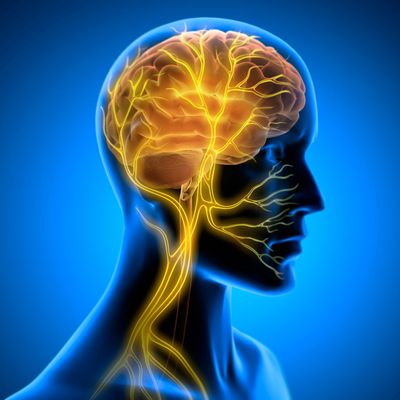
The sympathetic branch of the autonomic nervous system is important here. During an acute stress response, sympathetic activity helps mobilise the body for action, while the HPA axis contributes through hormonal responses involving cortisol. Catecholamines such as adrenaline and noradrenaline are also involved in the body's acute stress response.
Heart rate and blood pressure can increase, breathing changes, muscles tense and attention becomes more strongly directed towards potential threat. These responses make sense when something genuinely requires immediate action.
The parasympathetic nervous system is involved in the regulation that allows the body to move away from heightened activation. Anxiety becomes particularly exhausting when someone spends too much of his life feeling as though he needs to remain prepared.
This is the aspect of anxiety I think many men recognise once they have language for it. They aren't necessarily experiencing dramatic panic attacks. They may simply have forgotten what it feels like not to be slightly braced.
What anxiety can actually feel like
Anxiety isn't confined to worrying.
It can appear as a racing or pounding heart, tightness in the chest, shallow breathing, muscle tension, digestive disturbance, difficulty sleeping, irritability, restlessness and problems concentrating. Some people experience dizziness, sweating or trembling. For others the most noticeable feature is mental: persistent worry, catastrophic thinking, repeatedly checking possibilities or finding it almost impossible to tolerate uncertainty.
Then there is hypervigilance.
Hypervigilance is the experience of remaining unusually alert to potential danger, continually monitoring the environment for something that might go wrong. It can involve scanning surroundings, noticing changes in someone's expression or tone, reacting strongly to unexpected noises and finding genuine relaxation surprisingly difficult. Hypervigilance is strongly associated with PTSD, although it isn't exclusive to PTSD and can occur alongside anxiety and other experiences.
From inside the experience, it may not feel like anxiety at all.
It can simply feel like being prepared.
When thought becomes threat
The human mind doesn't need an external danger to begin this process.
A delayed message becomes evidence that something is wrong. An unfamiliar physical sensation becomes the possible beginning of serious illness. An upcoming conversation is rehearsed repeatedly because the mind believes that enough preparation might finally remove the uncertainty.
What makes anxiety particularly persuasive is the relationship between interpretation and physiology.
If I interpret something as threatening, my body may respond accordingly. Once my heart begins beating faster and my chest feels tight, those sensations can themselves become evidence that something really is wrong. The body confirms the thought, and the thought intensifies what is happening in the body.
This is why simply telling somebody to stop worrying is spectacularly useless.
The anxious man already knows he would rather not be anxious.
What he may not yet understand is the process that keeps the anxiety alive.
The old danger and the present moment
Not every anxious reaction begins with childhood or trauma, and I wouldn't approach a man assuming that it does.
But our history matters.
Someone who has spent years around unpredictable conflict may become exceptionally sensitive to a shift in another person's tone. A boy who learnt that mistakes brought criticism may become a man who experiences evaluation as something considerably more threatening than the present situation appears to justify. Someone accustomed to managing the emotional atmosphere around him may continue monitoring other people long after it is necessary.
This fits closely with what I describe elsewhere at Wolf Path as the Emotional Blueprint. We can carry forward expectations about what is dangerous, what must be controlled and what we need to do in order to remain safe.
The original situation may have disappeared years ago while the expectation remains.
Anxiety, trauma and PTSD
There is an important connection here, but anxiety and PTSD aren't interchangeable.
People can experience anxiety without having PTSD, and experiencing trauma doesn't automatically mean someone will develop PTSD. NIMH notes that many people experience reactions following traumatic events and recover over time; PTSD involves symptoms that persist and interfere with everyday life. People with PTSD may continue feeling frightened or stressed even though they are no longer in danger.
For somebody living with PTSD or trauma-related difficulties, anxiety may therefore form part of something broader. Hypervigilance, sleep disturbance, avoidance, intrusive memories and feeling continually on guard can all be relevant to understanding what is happening.
I think that deserves recognition without turning every anxious man into a trauma patient.
Sometimes the question isn't “What am I afraid of?” so much as “Why has my system become so convinced that it needs to stay prepared?”
When anxiety becomes physically expensive
This is one area where mind and body really cannot sensibly be separated.
The stress response is adaptive in the short term. Problems arise when stress systems remain engaged repeatedly or over prolonged periods. Research connects chronic stress with changes across hormonal, inflammatory and immune processes, and cortisol plays an important regulatory role within that relationship. The science is more complicated than saying that every cortisol surge simply “lowers the immune system”; both acute and chronic stress can affect immune activity differently. Prolonged stress and HPA-axis dysregulation, however, are associated with impaired immune regulation.
There is also good reason to take prolonged anxiety seriously from a cardiovascular perspective. Research has found an association between trait anxiety, sympathetic nerve activity and blood pressure, while broader cardiovascular research identifies psychological stress as relevant to cardiovascular-disease risk.
This doesn't mean anxiety inevitably makes somebody ill, nor does it mean a physical symptom should automatically be attributed to anxiety. New, unexplained or persistent physical symptoms deserve appropriate medical attention.
But it does mean that constantly living as though something might be about to happen is not merely an unpleasant way to think.
The body participates in that experience.
Learning not to believe everything you think
This became enormously important in my own experience of chronic anxiety.
For me, self-analysis, mindfulness and meditation changed my relationship with my thoughts. I began recognising that the appearance of a thought did not make it true, and that I didn't have to follow every frightening possibility until my mind eventually produced certainty.
Usually it never did.
Mindfulness wasn't about emptying my head or achieving some permanently tranquil state. It gave me enough distance to notice thinking as it occurred.
That distinction sounds simple, but it can be profound when you've spent years experiencing your thoughts as accurate reports of reality.
There is a difference between something happening and thinking that something might happen. Anxiety can make that boundary remarkably difficult to see.
My experience inevitably influences how I approach this work at Wolf Path, but I don't assume another man's anxiety began in the same place as mine or that his route through it will be identical.
We have to understand his anxiety, not mine.
Working with anxiety at Wolf Path
I am interested in reducing the distress anxiety causes, but I am equally interested in understanding what is sustaining it.
We might explore the thoughts that repeatedly create threat, the assumptions underneath them and what you do when anxiety appears. We may discover avoidance, reassurance seeking, overthinking, continual preparation or attempts to control uncertainty that provide temporary relief but keep the wider pattern alive.
Sometimes the work takes us further into your history and Emotional Blueprint. At other times what matters is learning to notice the relationship between thought and bodily reaction, allowing the system to settle without immediately feeding it another frightening interpretation.
The aim isn't to produce a man who never experiences anxiety. Fear and anxiety belong to being human, and sometimes they tell us something genuinely needs our attention.
What can change is the degree of authority anxiety has over your life.
If the alarm keeps sounding when there is no tiger, I don't think the answer is simply to become better at enduring the alarm.
I want to help you understand why it keeps sounding.